Read First
HBOT for Migraine — What It Involves
Quick answer: Published hyperbaric literature exploring migraine and cluster headache typically describes pressures around 1.5–2.0 ATA, but the evidence is limited and mixed; for cluster headache in particular, normobaric (non-pressurised) oxygen is more commonly referenced than hyperbaric. This is educational information, not medical advice — consult a qualified doctor. If HBOT is pursued, the equipment involved is a hard (clinical) hyperbaric chamber, which TheHBOT supplies from ₹15 lakh.
Important — educational information only. This page summarises what published hyperbaric oxygen therapy (HBOT) research and clinician protocols discuss. It is not medical advice, a diagnosis, or a treatment plan, and makes no claim to treat, cure or prevent any condition. If you are considering HBOT, consult a qualified doctor. TheHBOT supplies hyperbaric chambers (equipment) — we do not provide therapy or run sessions.
Migraine and cluster headache are among the areas that appear in published hyperbaric oxygen literature, but they sit in a different evidential position from the more established uses such as wound care. The published picture is limited and mixed: some small studies have explored hyperbaric oxygen for acute migraine and for cluster headache, while systematic reviews have generally called for better-quality evidence before drawing firm conclusions. We say this plainly because honesty about evidence status is part of doing this responsibly — and because it directly affects whether any equipment purchase makes sense for you.
Our purpose on this page is deliberately narrow and equipment-focused. We explain, for general education, what the published discussions involve, and then help with the part we are actually qualified for: supplying the hyperbaric chamber (the equipment) that a clinical protocol would use, if a doctor guides you toward one. We are a multi-brand aggregator and on-demand manufacturer, not a clinic; we do not diagnose, treat, run sessions, or make any claim that a chamber will relieve or prevent headache.
If you are an individual sufferer, the right first step is always a qualified doctor — ideally a neurologist or headache specialist — who can advise whether any oxygen approach, hyperbaric or normobaric, is appropriate for your situation. If you are a clinic exploring HBOT as a service, the equipment decision is where we add value: comparing chambers across five brands, arranging documentation, and delivering and supporting the unit across India. The rest of this page covers what published protocols typically describe, the important hyperbaric-versus-normobaric distinction, and which chamber matches, with a source to read further.
If you are a patient, the right first step is always a qualified doctor, who can advise whether HBOT is appropriate for your situation. If you are a clinic, recovery centre or hospital evaluating HBOT as a service, the equipment decision is where we help — comparing chambers across five brands, arranging documentation, and delivering and supporting the unit across India. The rest of this page covers what published protocols typically describe and which chamber matches, with a source to read further.
Summarises published protocols — not a diagnosis or treatment plan.
Whether HBOT suits you is a medical decision for a qualified doctor.
We source, deliver and install the chamber a protocol would use.
Clinics and hospitals: we compare, document and install the chamber.
India Pricing
The Chamber Migraine Protocols Would Use
Published migraine discussions describe clinical pressures, which points to a hard (clinical) chamber. Indicative India price bands:
| Chamber Type | Pressure | Primary Buyer | Indicative India Price | Get Price |
|---|---|---|---|---|
| Soft / Portable | 1.3 – 1.5 ATA | Home, wellness, athletes | ₹3.5 – 12 lakh | Enquire → |
| Hard Monoplace | 1.5 – 3.0 ATA | Clinics, hospitals | ₹15 – 40 lakh | Enquire → |
| Hospital Multiplace | 2.0 – 3.0 ATA | Hospitals, wound-care | ₹40 lakh – 1.5 crore+ | Enquire → |
For the equipment detail see the hard chamber page. Read more on HBOT generally at Hyperbaric medicine.
Product Range
Which Chamber Type Matches Published Protocols
Here is how the chamber types compare, so you can see why migraine discussions point to a hard chamber.
Inflatable fabric-shell units from OxyHealth and Summit to Sea. Compact, self-install.
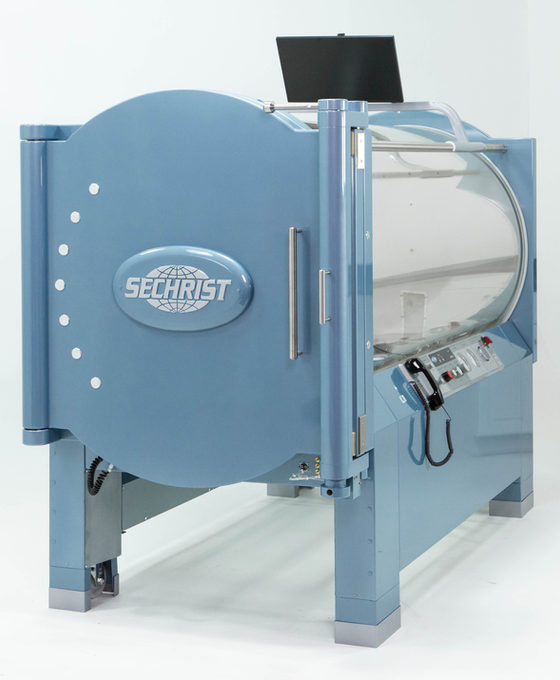
Rigid-shell monoplace units from Sechrist for hospitals and specialist clinics.
Carry-case designs from Summit to Sea. Travel-ready for athletes and mobile practitioners.
Multiplace systems from Perry Baromedical and Fink. 2–18 patient capacity, AERB docs.
The Detail
What Published Protocols Describe — and the Equipment
What HBOT for migraine involves (educational)
In the terms discussed in published hyperbaric literature, hyperbaric oxygen therapy places a person inside a sealed chamber and raises the pressure so that more oxygen is absorbed than at normal atmospheric pressure. For headache-related studies, the pressures referenced generally sit around 1.5–2.0 ATA, delivered in sessions under supervision. The proposed rationale in the literature relates to oxygen’s effects on blood vessels and inflammation, but we present this only to inform your reading and your conversation with a doctor. It is not a recommendation, a protocol for you to follow, or a claim that HBOT will abort or prevent a migraine. Whether any oxygen approach is appropriate for a specific person is a medical judgement, and headache in particular has well-established first-line treatments that a specialist would consider first.
What the published evidence actually says
It is worth being precise about evidence status, because it is easy to encounter strong online claims that the research does not support. Published work on hyperbaric oxygen for migraine is limited, and reviews have generally described the studies as small or of variable quality, calling for larger, better-controlled trials before firm conclusions can be drawn. For cluster headache, the more commonly referenced oxygen approach in the literature is normobaric — high-flow oxygen at normal pressure — rather than hyperbaric. None of this means the topic is closed; it means an honest reading is cautious, and it means a buyer should not purchase equipment on the assumption of a proven headache benefit. Your specialist is the right person to weigh this evidence for your case.
The hyperbaric-versus-normobaric distinction (why it changes the equipment)
This is the pivotal, practical point for anyone considering an oxygen purchase for headache. Normobaric oxygen — breathing enriched oxygen at ordinary atmospheric pressure through a mask — requires an oxygen concentrator or cylinder and a suitable mask, and no chamber at all. Hyperbaric oxygen requires a pressurised chamber to raise the ambient pressure. These are fundamentally different equipment paths at very different price points. If a doctor is recommending oxygen for cluster headache, they very often mean the normobaric route, in which case a chamber would be the wrong purchase. We would always clarify which is intended before quoting equipment, because getting this wrong is expensive and unnecessary.
Why a hyperbaric protocol points to a hard (clinical) chamber
If, after that clarification, a genuinely hyperbaric protocol at 1.5–2.0 ATA is what your doctor is discussing, the equipment consequence is a clinical chamber. Pressures approaching 2.0 ATA exceed what a mild soft chamber (1.3–1.5 ATA) can provide, which points to a rigid hard chamber — a monoplace clinical unit for a single user, or a multiplace system where a facility treats several people. Soft home chambers, which cap at mild pressures, are not the equipment a 2.0 ATA hyperbaric headache protocol would use. Matching the chamber’s pressure capability to what a doctor actually describes is exactly the part we help with, across five brands rather than one.
Chamber configuration a clinic would consider
For a clinic or specialist practice weighing hyperbaric equipment, the configuration follows expected use. A monoplace hard chamber suits single-patient sessions and a lower capital outlay; a multiplace system suits higher throughput but needs more space, more complex controls and a larger investment. Because headache is an episodic condition, realistic session volume is worth modelling honestly before choosing capacity — an idle multiplace earns nothing, while an over-subscribed monoplace becomes a bottleneck. We size the chamber to your expected demand and provide the technical documentation your biomedical team needs, while the clinical protocol and patient selection stay with your specialists.
India-specific equipment considerations
For an Indian clinic, the equipment picture also involves import and installation. Clinical chambers are frequently imported, so the honest figure is the landed, installed cost — freight, customs, GST, delivery and on-site commissioning. There is also the facility side: electrical supply, oxygen handling and fire safety, since concentrated oxygen supports combustion. We act as importer of record, quote an all-in ₹ price, and coordinate installation and commissioning across Indian cities. AERB, incidentally, governs ionising radiation and is generally not the relevant clearance for a chamber; the meaningful documentation is the manufacturer’s pressure-vessel and build certification, which we supply with every genuine unit.
A cautious, buyer-first conclusion
Headache is the one topic on this site where our most useful advice is often “you may not need a chamber at all.” Given the limited hyperbaric evidence and the prominence of the normobaric route, an individual sufferer should let a neurologist lead, and should be sceptical of any seller promising headache relief from a chamber. If a clinic, guided by clinical judgement, decides to offer hyperbaric oxygen as one service among many, we are glad to supply and install the right chamber. Either way, our role is strictly equipment: we do not treat, we do not run sessions, and we will not overstate what the research supports in order to make a sale.
Questions worth taking to a headache specialist
If you are weighing any oxygen approach for headache, a short list of questions can save a great deal of money and disappointment. First: are you recommending normobaric oxygen or hyperbaric oxygen — because only one of them needs a chamber? Second: what does the current evidence actually support for my specific headache type, migraine or cluster? Third: have the established first-line options been exhausted, and where would oxygen sit relative to them? Fourth: if hyperbaric is being suggested, what pressure and how many sessions, and in what supervised setting? Fifth: what outcome, realistically, should I expect, and how would we know if it is not working? These are ordinary questions a good specialist will welcome. They also happen to be the questions that determine whether you need any equipment at all, and if so, which — which is precisely why we would rather you ask them before speaking to any equipment seller, including us.
Red flags when someone sells you a chamber for headaches
Because headache is common and often poorly controlled, it attracts confident marketing that outruns the evidence, so a few red flags are worth knowing. Be wary of any seller who guarantees migraine relief or presents hyperbaric oxygen as a proven headache cure — the reviewed evidence does not support that certainty. Be cautious if a seller blurs the line between normobaric and hyperbaric oxygen, or steers you toward an expensive chamber when a simpler oxygen-delivery setup is what your doctor described. Treat pressure to buy quickly, or claims that a home chamber replaces specialist care, as reasons to slow down. A responsible equipment supplier will tell you when the evidence is weak, will clarify which kind of oxygen your doctor means, and will happily lose a sale rather than sell you a chamber a normobaric plan does not require. That is the standard we hold ourselves to, and it is a fair one to hold any seller to.
How an honest headache enquiry actually works with us
It may help to know how we would handle a real enquiry about oxygen for headache, because it illustrates where equipment fits and where it does not. When someone messages us about migraine or cluster headache, our first response is not a quote — it is a question: has a doctor recommended oxygen, and did they specify normobaric or hyperbaric? If the answer points to normobaric oxygen, which is common for cluster headache, we explain that this is an oxygen-delivery setup — a concentrator or cylinder and a mask — not a chamber, and we do not try to convert that into a chamber sale. If a doctor has genuinely specified a hyperbaric protocol at a defined pressure, we then talk equipment: the chamber class that pressure implies, the configuration for a home or clinical setting, the delivered India price, import and installation, and ongoing support. Throughout, we are explicit that we make no promise about headache outcomes, that the evidence is limited, and that a specialist should remain in charge. Buyers sometimes expect a hard sell and are surprised to be told they may not need a chamber; we would rather earn trust that way than book revenue on a purchase that a clearer conversation would have avoided. That posture is not charity — it is simply what responsible equipment supply looks like on a topic where the evidence is thin and the marketing is loud.
Hyperbaric versus normobaric oxygen for headache
One distinction matters more for headache than for almost any other topic on this site, and it is an equipment distinction. A great deal of the oxygen discussion around headache — especially cluster headache — concerns normobaric oxygen: breathing high-flow oxygen at normal atmospheric pressure, which does not require a hyperbaric chamber at all. Hyperbaric oxygen, delivered inside a pressurised chamber, is a separate and less-established line of enquiry for migraine. We flag this because it changes what, if anything, you would actually buy: a normobaric approach involves an oxygen concentrator or cylinder and a delivery mask, not a chamber, whereas a hyperbaric protocol at 1.5–2.0 ATA would point to a clinical chamber. If your doctor is discussing oxygen for headache, clarifying which of the two they mean is the single most useful question before any equipment conversation — and we would rather tell you that plainly than sell you a chamber a normobaric plan does not need.
Equipment, compliance and installation
Adding an HBOT capability is an equipment and facility decision as much as a clinical one. Beyond the chamber itself there is AERB and facility planning, oxygen supply and fire safety, installation, warranty and after-sales. As a multi-brand aggregator we bring the chamber options together, provide the technical documentation your facility and biomedical teams need, and coordinate delivery and installation across India. What we deliberately do not do is advise on clinical protocols or patient care — that stays with your medical team.
How we help — equipment only
To be clear about our role: TheHBOT.com supplies hyperbaric chambers and, where useful, builds them to specification on demand. We compare OxyHealth, Sechrist, Summit to Sea, Perry Baromedical and Fink, source genuine units, and deliver, install and support them across India. We do not provide therapy, run sessions, diagnose, or make claims about outcomes. If you or your facility, guided by a qualified doctor, decide to pursue HBOT for migraine and cluster headache, tell us the pressures your protocol calls for, your capacity and your city, and we will recommend the best-fit chamber and return a delivered India price — usually within one business day.
Buying Guide
If You're Evaluating a Chamber
For anyone considering migraine HBOT equipment, tell us these and we can specify the right chamber.
Clinical pressures — What ATA does your protocol call for (per your doctors)?
Capacity — Single-patient monoplace, or multiplace for several?
Setting — Home, clinic, hospital or recovery centre?
Compliance — AERB and facility documentation needed?
City — Where should we deliver and install?
Explore Pricing & Options
Compare Before You Buy
Continue to the page that matches where you are in your decision.
FAQ
HBOT for Migraine — Questions
Common equipment questions — always confirm medical suitability with a doctor.