Read First
HBOT for Multiple Sclerosis (MS) — What It Involves
Quick answer: Published hyperbaric protocols historically explored multiple sclerosis at mild-to-moderate pressures (around 1.5–2.0 ATA), but systematic reviews have generally not found consistent evidence of benefit; any decision is firmly a matter for a neurologist. This is educational information, not medical advice — consult a qualified doctor. If HBOT is pursued, the equipment involved is a hard (clinical) hyperbaric chamber, which TheHBOT supplies from ₹15 lakh.
Important — educational information only. This page summarises what published hyperbaric oxygen therapy (HBOT) research and clinician protocols discuss. It is not medical advice, a diagnosis, or a treatment plan, and makes no claim to treat, cure or prevent any condition. If you are considering HBOT, consult a qualified doctor. TheHBOT supplies hyperbaric chambers (equipment) — we do not provide therapy or run sessions.
Multiple sclerosis (MS) is a chronic condition of the central nervous system in which the immune system affects the protective covering of nerve fibres, producing a wide and variable range of neurological symptoms. MS has a notably long association with hyperbaric oxygen: it was among the conditions for which hyperbaric therapy was offered from the 1980s, and dedicated therapy centres in some countries have historically operated mild chambers for people with MS. That history makes MS one of the more recognisable topics in this area.
It also makes honesty especially important. Despite the long history of use, systematic reviews of the controlled evidence have generally not found that hyperbaric oxygen produces a consistent, clinically meaningful benefit in MS. We present that plainly. Our purpose on this page is not to endorse or dismiss, but to explain — for general education — what published protocols historically described, and then to help with the part we are qualified for: supplying the hyperbaric chamber (the equipment) a protocol would use, if a doctor guides you toward one. We are a multi-brand aggregator and on-demand manufacturer, not a clinic; we do not diagnose, treat, run sessions, or claim any effect on MS.
If you or a family member is living with MS, a neurologist is the right person to lead any decision, weighing the reviewed evidence against the many established disease-modifying and symptomatic treatments now available. If you are a therapy centre or clinic that operates or is considering mild hyperbaric equipment, the chamber decision is where we help — comparing options across five brands, arranging documentation, and delivering and supporting the unit across India. The rest of this page covers what protocols historically described, what the reviews concluded, and which chamber matches, with a source to read further.
If you are a patient, the right first step is always a qualified doctor, who can advise whether HBOT is appropriate for your situation. If you are a clinic, recovery centre or hospital evaluating HBOT as a service, the equipment decision is where we help — comparing chambers across five brands, arranging documentation, and delivering and supporting the unit across India. The rest of this page covers what published protocols typically describe and which chamber matches, with a source to read further.
Summarises published protocols — not a diagnosis or treatment plan.
Whether HBOT suits you is a medical decision for a qualified doctor.
We source, deliver and install the chamber a protocol would use.
Clinics and hospitals: we compare, document and install the chamber.
India Pricing
The Chamber Multiple Sclerosis (MS) Protocols Would Use
Published multiple sclerosis (ms) discussions describe clinical pressures, which points to a hard (clinical) chamber. Indicative India price bands:
| Chamber Type | Pressure | Primary Buyer | Indicative India Price | Get Price |
|---|---|---|---|---|
| Soft / Portable | 1.3 – 1.5 ATA | Home, wellness, athletes | ₹3.5 – 12 lakh | Enquire → |
| Hard Monoplace | 1.5 – 3.0 ATA | Clinics, hospitals | ₹15 – 40 lakh | Enquire → |
| Hospital Multiplace | 2.0 – 3.0 ATA | Hospitals, wound-care | ₹40 lakh – 1.5 crore+ | Enquire → |
For the equipment detail see the hard chamber page. Read more on HBOT generally at Hyperbaric medicine.
Product Range
Which Chamber Type Matches Published Protocols
Here is how the chamber types compare, so you can see why multiple sclerosis (ms) discussions point to a hard chamber.
Inflatable fabric-shell units from OxyHealth and Summit to Sea. Compact, self-install.
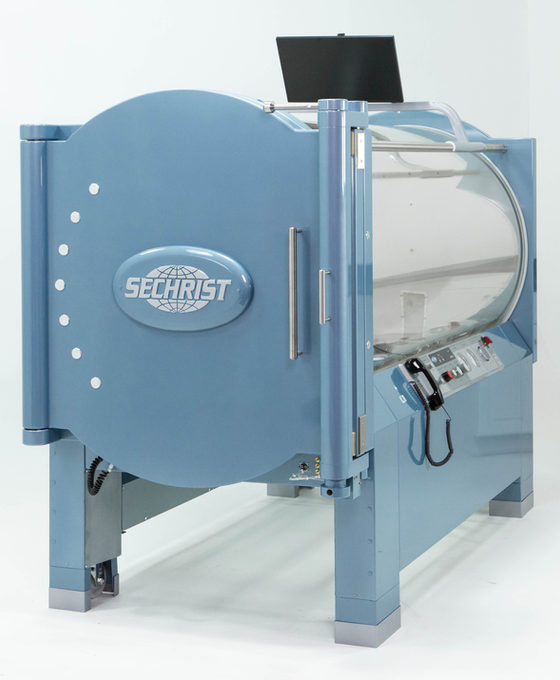
Rigid-shell monoplace units from Sechrist for hospitals and specialist clinics.
Carry-case designs from Summit to Sea. Travel-ready for athletes and mobile practitioners.
Multiplace systems from Perry Baromedical and Fink. 2–18 patient capacity, AERB docs.
The Detail
What Published Protocols Describe — and the Equipment
What HBOT for MS involves (educational)
In the terms used in the hyperbaric literature, hyperbaric oxygen therapy places a person inside a sealed chamber at raised pressure so that more oxygen is absorbed than at normal atmospheric pressure. Historic MS protocols generally described mild-to-moderate pressures, commonly around 1.5–2.0 ATA, delivered as a course of sessions, sometimes with periodic maintenance. The proposed rationale related to oxygenation of affected tissue. We describe this only to inform your reading and your conversation with a neurologist; it is not a protocol for you to follow, nor a claim that HBOT alters the course of MS or relieves its symptoms. Any such judgement is medical and individual.
What the systematic reviews concluded
Because MS has been studied more than many topics here, there is a clearer evidence picture — and it is important to represent it accurately. Systematic reviews of the randomised evidence have generally concluded that hyperbaric oxygen does not produce consistent, clinically significant benefits for people with MS, and have not recommended it as a treatment. Individual accounts and long-standing use exist, but reviewed controlled evidence is the more reliable guide, and it is cautious. We share this so that any equipment decision is made with eyes open, and so that no one buys a chamber on the basis of an efficacy the reviews do not support.
Why MS therapy centres historically used mild chambers
A point of practical interest is that where MS hyperbaric use has existed, it has typically involved mild pressures rather than high clinical pressures — which is why MS therapy centres historically operated soft or low-pressure chambers rather than 3.0 ATA clinical units. This is an equipment observation, not an endorsement: it means that where such use continues, the relevant category tends to be a mild chamber. It also means the equipment cost profile differs from, say, wound-care HBOT, which requires higher-pressure hard chambers. Your neurologist remains the right person to advise whether any of this is relevant to you.
What pressure implies for the chamber type
On the equipment side, the pressure a protocol specifies decides the chamber. Mild pressures around 1.3–1.5 ATA fall within what a soft chamber provides, which is the home-capable, self-installing category historically associated with MS use. Pressures approaching 2.0 ATA exceed a soft chamber’s range and imply a rigid hard chamber in a supervised setting. So the honest equipment answer for MS is “it depends on the specified pressure,” spanning a soft chamber from around ₹3.5 lakh to a clinical hard chamber from around ₹15 lakh. We match the equipment to what a doctor actually describes, never over-specifying.
For therapy centres and clinics
A therapy centre operating or considering mild hyperbaric equipment is making an equipment and facility decision. Beyond the chamber, there is oxygen supply, electrical provision, placement and routine maintenance, plus the documentation an organisation needs. We compare mild soft chambers and, where higher pressures are specified, hard chambers, across five brands; we source genuine, documented units; and we deliver, install and service them across India with AMC. We deliberately stay on the equipment side — we do not advise on whether to offer hyperbaric oxygen for MS, which is a clinical and organisational judgement informed by the evidence.
Equipment, import and installation in India
For an Indian buyer, the practicalities are the same as for other chambers: genuine sourcing, a landed cost for imported units (freight, customs, GST, delivery), self-installation for soft chambers or on-site commissioning for hard ones, and attention to oxygen handling and fire safety. AERB governs ionising radiation and is generally not the relevant clearance for a chamber; the meaningful paperwork is the manufacturer’s pressure-vessel and build certification, which we provide. We act as importer of record, quote an all-in ₹ price, and remain the accountable India service contact. We supply only genuine units with warranty and authentic spares.
Straight dealing on a well-known topic
MS is a condition where hope and long history can outrun the evidence, so our commitment is to represent the picture honestly and stay strictly on the equipment side. We do not claim hyperbaric oxygen benefits MS, we do not offer medical advice, and we do not run sessions. If a neurologist, having weighed the reviewed evidence, guides you or your centre toward a hyperbaric protocol, tell us the pressures involved, the setting and your city, and we will recommend the right chamber and quote a delivered India price. If a chamber is not the right answer, we will say so. Read more on the field generally via the source below, and let a qualified specialist lead.
What today’s MS treatment landscape means for the decision
A piece of context matters for anyone weighing hyperbaric oxygen for MS in 2026: the treatment landscape has changed profoundly since the 1980s, when much of the hyperbaric interest arose. There is now a substantial range of disease-modifying therapies and structured symptomatic and rehabilitative approaches, prescribed and monitored by neurologists, with a far stronger evidence base than hyperbaric oxygen has accumulated for MS. This is not a reason to be dismissive of anyone’s experience, but it is an important frame: a decision about hyperbaric oxygen today is made alongside options that did not exist decades ago, which is exactly why a current neurologist, rather than historical precedent or online enthusiasm, should lead. On the equipment side we take no view on that clinical hierarchy; we simply make sure that if a chamber is genuinely part of a considered plan, it is the right one, correctly specified and installed.
Questions worth taking to your neurologist
If you or a family member is considering hyperbaric oxygen for MS, a focused set of questions helps keep the decision grounded. Ask: given the reviewed evidence, do you see any role for hyperbaric oxygen in my case, and how does it compare with the disease-modifying and symptomatic options you would prioritise? If you would consider it, what pressure and schedule, and would that be a mild home-capable approach or a supervised clinical one? What realistic outcome should I expect, over what period, and how would we judge whether to continue or stop? What are the costs and burdens, and are they justified relative to alternatives? Am I at risk of delaying more established treatment by pursuing this? These questions turn a familiar-sounding but uncertain option into a properly informed choice. They also determine whether any chamber is appropriate and, if so, its category — the only point at which our equipment role becomes relevant, and one we will fill honestly or not at all.
Weighing cost against opportunity cost
A specific idea is worth naming for MS, because it is where hyperbaric decisions most often go wrong: opportunity cost. The money and time spent pursuing an approach with limited reviewed evidence are money and time not spent on the disease-modifying and rehabilitative options a neurologist would prioritise, which have a stronger basis. That does not make hyperbaric oxygen forbidden — a specialist may still consider it as an adjunct in a considered plan — but it does mean the decision should account for what else the same resources could buy. On the raw equipment cost, the range is wide: a mild soft chamber suited to the pressures historically used for MS starts around ₹3.5 lakh, while any clinical-pressure setup is a larger commitment; for a therapy centre, a chamber is a capital asset whose utilisation and running costs also matter. We lay out the equipment economics honestly so they can be set against alternatives, but we do not and cannot advise on the clinical trade-off — that is squarely a matter for a neurologist who knows the person and the current options. Our commitment is simply that the equipment figure we give is accurate and complete, so that whatever decision is made is made on real numbers rather than an optimistic sketch, and so that no one buys a chamber for MS believing it does more than the evidence supports. It is also worth remembering that MS is a highly variable condition that naturally fluctuates, with relapses and remissions that can make any intervention appear effective by coincidence of timing; this is one of the reasons controlled trials, rather than personal impressions, carry the weight in the reviews, and one more reason to let a neurologist interpret both the evidence and your own response rather than an equipment supplier or an online forum. In short, we are glad to be the equipment partner in a plan a neurologist genuinely supports, and equally glad to say plainly when a chamber is not the answer.
A long history — and what the reviews concluded
Multiple sclerosis occupies an unusual place in the hyperbaric story because it has a longer and more visible history than most conditions here. From the 1980s onward, hyperbaric oxygen was offered for MS in a number of settings, and MS therapy centres in some countries have long operated mild chambers. That history is exactly why honesty matters: despite the visibility, systematic reviews of the controlled trials have generally concluded that the evidence does not support a consistent, clinically meaningful benefit for MS. We raise this not to dismiss anyone’s experience, but because a buyer deserves to know that the weight of reviewed evidence is cautious, and that the long history of use is not the same thing as proven efficacy. A neurologist is the right person to weigh this for an individual, and we will not let the topic’s familiarity substitute for that judgement.
Equipment, compliance and installation
Adding an HBOT capability is an equipment and facility decision as much as a clinical one. Beyond the chamber itself there is AERB and facility planning, oxygen supply and fire safety, installation, warranty and after-sales. As a multi-brand aggregator we bring the chamber options together, provide the technical documentation your facility and biomedical teams need, and coordinate delivery and installation across India. What we deliberately do not do is advise on clinical protocols or patient care — that stays with your medical team.
How we help — equipment only
To be clear about our role: TheHBOT.com supplies hyperbaric chambers and, where useful, builds them to specification on demand. We compare OxyHealth, Sechrist, Summit to Sea, Perry Baromedical and Fink, source genuine units, and deliver, install and support them across India. We do not provide therapy, run sessions, diagnose, or make claims about outcomes. If you or your facility, guided by a qualified doctor, decide to pursue HBOT for multiple sclerosis, tell us the pressures your protocol calls for, your capacity and your city, and we will recommend the best-fit chamber and return a delivered India price — usually within one business day.
Buying Guide
If You're Evaluating a Chamber
For anyone considering multiple sclerosis (ms) HBOT equipment, tell us these and we can specify the right chamber.
Clinical pressures — What ATA does your protocol call for (per your doctors)?
Capacity — Single-patient monoplace, or multiplace for several?
Setting — Home, clinic, hospital or recovery centre?
Compliance — AERB and facility documentation needed?
City — Where should we deliver and install?
Explore Pricing & Options
Compare Before You Buy
Continue to the page that matches where you are in your decision.
FAQ
HBOT for Multiple Sclerosis (MS) — Questions
Common equipment questions — always confirm medical suitability with a doctor.